TANNER THETFORD . COM
  • Home
  • Sermons
  • Bible Studies
  • Blog
  • Contact

Devotional Thoughts: Kicking Against the Goads

8/17/2014

0 Comments

 
When it comes to translating anything out of another language, idioms are often one of the most difficult things to deal with. You are faced with an unavoidable dilemma. Do you translate the idiom directly as it appears and potentially lose your readers in terms of their understanding? Or, do you try and give the thought of the idiom instead, sacrificing a word for word translation? Our Bibles are full of idioms, and translators of all the English versions have had to wrestle with this very issue. One such idiom appears in Acts 26:14, and nearly all English translations have sought to translate it literally. What then, does it actually mean?
‘Saul, Saul, why are you persecuting me? It is hard for you to kick against the goads.’ Acts 26:14.
A goad is not something that we are terribly familiar with in our society today. A good practice when you run across an unfamiliar term in the Bible is to see how else it is used in Scripture. This will often give you a good idea of what the term actually means. Remember however, that the term that is important to look up is the original Greek or Hebrew term, as often times the English equivalents are translated differently. This is where a trusty old concordance can be a handy tool.

The Greek term uses here for goad is κέντρον (kentron).
The term is used only a few other times in the New Testament. Paul uses the exact same term in 1 Corinthians 15 when he discusses the resurrection:
   "O death, where is your victory?
   O death, where is your sting?”
   The sting of death is sin, and the power of sin is the law.  1 Cor 15:55–56.
The term is translated here in the ESV as "sting." A similar image is given for us in the Revelation of John:
They have tails and stings like scorpions, and their power to hurt people for five months is in their tails. Rev 9:10.
So the primary meaning of the word is something sharp or pointy like a stinger. Paul uses it in a more metaphorical sense, while John uses it in a more literal sense. However, that only gets us half way to properly understanding our idiom. We realize that a goad is something sharp, but why would anyone kick something sharp? This is where a little more cultural understanding can fill in the rest of the gaps. A good Bible Dictionary can help with this piece of the puzzle.
Goad. A sharpened metal point on the end of a long pole. Goads were used by farmers to prod animals to keep them moving1
Picture
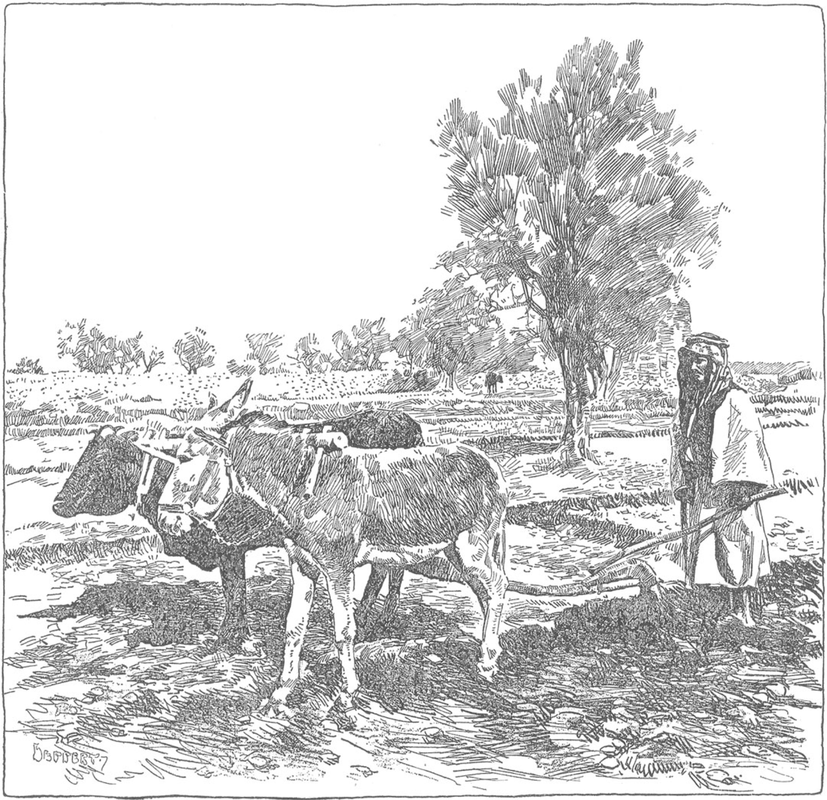
You can see in the illustration above that the man is holding a goad in his left hand. So, as a tool, a goad was a "stinger" or sharp point attached to the end of stick, to keep prodding the oxen or donkey forward while plowing. It served to keep the worker a safe distance away while he spurred on the animals to keep working.

Why would he need to be a safe distance away? If you have ever worked on a farm or around horses, you know to stay out of the blind spots of these animals. Their kicks are strong and if they connect, they could do some serious damage.

What does all of this have to do with Paul? Well, you could imagine that if a worker were using a goad on an animal, that it might be inclined to kick. However, that would not help at all, and in fact it would only serve to hurt the mule further, as its foot would connect directly with a sharp point! This is the crucial insight for understanding the Lord's rebuke of Paul in our text. It is not just simply that Paul was being stubborn and refusing to submit to God, but in fact he was hurting himself all the while! Ben Witherington III summarizes this idiom perfectly for us:
In Jesus’ message to Saul/Paul spoken from heaven, the reference to κέντρα was a metaphorical way of saying that as Saul was persecuting the church, he was actually hurting himself. Saul was sinning against God by resisting God’s plan for his life. And . . . he is hurting himself.

God’s message to us is the same. The more we sin against God, the more we resist his plan for our lives, and the more we tune out his call into our lives, the more pain we will feel. Indeed, we are only hurting ourselves when we keep running into the brick wall of sin. Later on in life we may, like Paul, wonder whether God perhaps considers us the chief of sinners. But, as God showed his forgiving mercy to Paul, he will show his forgiving mercy to us if we repent of our sins, turn to Jesus Christ as Lord, and accept his will for our lives.3
Something we often don't believe God about is the fact that his regulations and commandments are for our own good. We get the picture in our heads that the Christian life is a drag, and we are kept from doing the things we really want to do just because God said. Beloved, God is not a cosmic killjoy out to ruin all of our fun! That is a lie and the world has swallowed it hook, line, and sinker. Rather, God's commands and instructions for us are really for our own good and happiness! I can promise you that if you are a true believer in Jesus Christ, that you will never find more joy and satisfaction in your life than when you are being obedient to him and following his will. Brothers and sisters, let's learn from Paul and stop kicking against the goads.

-tanner

1 Ronald F. Youngblood, F. F. Bruce, and R. K. Harrison, Thomas Nelson Publishers, eds., Nelson’s New Illustrated Bible Dictionary (Nashville, TN: Thomas Nelson, Inc., 1995).
2 Myers, Richard. Images from A Standard Bible Dictionary. Bellingham, WA: Logos Bible Software, 2012.
3 Ben III Witherington, “Kicking Against the Goads (Acts 26:14),” in Devotions on the Greek New Testament: 52 Reflections to Inspire & Instruct, ed. Verlyn D. Verbrugge and Scott J. Duvall (Grand Rapids, MI: Zondervan, 2012), 57.
0 Comments

Theology: The Three Uses of the Law in Light of the Sixth Commandment

8/16/2014

0 Comments

 
The law has several uses and functions throughout the entirety of Scripture. Many of the misunderstandings regarding the law by various groups have come about due to focusing too much on one use of the law to the exclusion of other uses. Traditionally, three primary uses of the law have been identified. The law has: a civil use, is a mirror, and is a guide.  It is far more helpful to see various uses of the law from a perspectival approach, emphasizing different aspects rather than competing with one another. In analyzing the sixth commandment for example, we can expand our understanding of the regulation by approaching it from the traditional three perspectives.

The first use to discuss is the civil use. The civil use of the law is primarily focused upon how the law restrains evil in sinners within society. It is this use of the law that the apostle Paul discusses in 1 Timothy 1:8-11 when he says that the law is laid down for the "lawless and disobedient." This function of the law is to establish order and regulation in society so that people will not act simply as they see fit, but actually have consequences for their actions. In regards to the sixth commandment, this use of the law establishes a paradigm for structure in society. Murdering is unacceptable and should not be tolerated among any societies. Furthermore, this is the case not because of some general consensus or majority vote, but due to divine fiat. The creator of all things has declared that man shall not murder one another. This command establishes a basis for government's to "bear the sword" or punish those who would violate their creator's command. While capital punishment for such a crime is not proven per se, punishment of some type is hinted at and expected if such a law is to be enforced consistently.

The second use of the law is as a mirror. In particular this use of the law focuses on convincing us individually of our sin. Paul hints at this use when he describes the law as our "schoolmaster" in the book of Galatians. Here the law is read by an individual and they begin to realize that something they have done is wrong by the standards of God. This use is associated closely with the convicting work of the Holy Spirit. Using the law as a mirror, God makes us to see ourselves in our true light: as sinners. In regards to the sixth commandment, this use convicts people who have murdered of their sin, ideally with the end of bringing them to Christ as their only hope before their God. In the sermon on the mount Jesus makes this use even more powerful, as he proclaims that everyone who hates is brother is a murderer as well. Jesus gets to the heart of the matter showing that even committing the act is unnecessary, it is the thoughts and intentions of our hearts that make us filthy sinners before a Holy God.

The third use of the law is as a guide. This use of the law is especially relevant to believers. The law as a guide establishes the parameters of how God would like his people to live. In a sense this is God's revealed will to us, and we are expected to conduct ourselves in such a way that he would be pleased. For the sixth commandment, this makes it clear that God does not want his people to be characterized by murder. Far from having the prerogative to live however they like because they are "under grace;" God's people are expected to know his desires for their conduct and live accordingly. Murder itself can be a sticky subject in terms of how it is to be defined. It seems that manslaughter, killing in war, and murder are differentiated in the OT itself. However after careful study of God's Word, whatever murder is defined as, God's people should not be engaged is such practices.

The commandments and laws of the OT are just as relevant for God's people today as they were during the time of Moses. The question is not whether they are relevant, but rather how they are relevant. A careful consideration of the three uses of the law can keep us on track and stop us from heading too far into the directions of legalism or licentiousness.

0 Comments

Self-Esteem: An Admirable End, but the Wrong Means

8/15/2014

0 Comments

 
We are more affected by our society and culture than we know. In many ways, we have been bombarded with false ideas and incorrect assumptions that color how we view the world around us. When those assumptions and ideas are not checked against the Word of God, they can be adopted into our worldview web even though they run counter to scriptural affirmation. One such false idea is that of self-esteem.

A quick google search of the term self-esteem yielded no less than 4-5 websites dedicated to recognizing the importance
of self-esteem, on the first page. They tell you what self-esteem is, what it means for you, and how to improve it. They have tests and quizzes you can take so that you can identify if you need help. In short, this topic is very important to a lot of people, and they feel it needs to be addressed.

A word about how NOT to address this topic. I am going to say little in this post that is original (that could really be said for all of my posts). I'm sure you have heard people discuss the topic of self-esteem before. Likely you have even heard those that explained the fact that they were against self-esteem as well. Perhaps you even know people that rant and rave against this idea. I would like to suggest that those who do so are going about addressing this topic the wrong way. All ranting and raving gets you is a bunch of people in your corner who already believed the same way you do, and everyone who doesn't agree with you writes you off and they won't hear another word you say. I am likely going to arrive at the same conclusion as these people, but I hope to use means that will resonate with people, even those that may disagree.

Self-esteem is essentially tied to how we perceive ourselves. As such, it is linked fundamentally with the idea of identity. Who are you?

The goal of self-esteem is admirable, let me describe what I believe is happening from a spiritual perspective. Self-esteem comes primarily from the movement and perspective of secular humanists. Their answer to the fundamental question of identity is grim indeed. Secular science asserts that there is no creator and we arrived here through entirely natural causes over long periods of time. Consequently, everything you are can be reduced to physical processes acting on physical matter. Immaterial things such as souls, beauty, and love do not exist, or can be explained by entirely naturalistic phenomena. Now all of these concepts and ideas may not be fully formulated or discussed by the secularist. They may not even affirm all of these either. However, this is the consistent worldview web that is produced from their affirmed ultimate authority, and anywhere they do not affirm these things they are (praise God) being inconsistent.

So what is your identity if these beliefs are affirmed? Your identity is essentially worthless. Not only are you a mere animal, the fact that you are derived
from non-living matter at your core makes you less than an animal. Human beings have no value or transcendent meaning, and survival of the fittest reigns supreme. What is the difference between a ball bouncing off of a wall and a bullet colliding with somebody's brain? Nothing. They are simply atoms banging into each other. The bullet does not take a life, because life itself is simply natural processes in the body and brain, the fact that they are ended is irrelevant.

The movement of self-esteem is a radical reaction against the conclusions outlined in the paragraph above. Because we are made in the image of God, all human beings react violently against the idea that we are simply natural processes. We KNOW we are more than that and as
such refuse to accept the conclusions of the naturalistic worldview. However, secular humanism refuses to abandon the presuppositions that lead to the conclusions they hate. Instead, they seek to (inconsistently) establish a different foundation for humanity's worth. Unfortunately since they have already abandoned God, everything they propose is ultimately insufficient.

Self-esteem manifests itself in and abundance of ways. Positive thinking and appealing to the universe abound. Motivational speakers and media seek to appeal to your inner nature, but lack the truth content for a sustainable perspective. The emotion and feelings wane and there is no truth to keep you driven. Ultimately self-esteem is vapid and empty. This is because it advocates a pull yourself up by your own bootstraps type of mentality. If YOU think positively, if YOU say to yourself, if YOU take charge. This boils down to the basic works-righteousness mentality that nearly all false religions fall into, and it is profoundly unbiblical.

What is the alternative? The alternative drives at the root of what self-esteem is and is trying to cure.
As I asked earlier, who are you?

You are a human being created in the image of God. The image of God in every single human being is what gives us our value and worth. Ironically, promoting your true identity is then done in the very opposite manner than the world pursues it.

Rather than trying to build and lift you up with positive words and affirmations, the Bible does everything in its power to tear you down. This is because your value and worth has nothing to do with you and everything to do with who made you.

Read the first 3 chapters of Romans sometime and tell me that your worth is found in yourself. It's not there, it's not anywhere in the Bible. Using various means and methods in our life, God often brings us to rock bottom. Why would a loving God do that?

The more you are trusting in yourself and your own strength and your own worth to give yourself meaning, the further you are from your true identity. God brings us down so that he can build us up on a proper foundation. From the depths of the pit look at yourself and your life and see how much you are worth. All you bring is your sin. Nothing but iniquity and transgression. Any yet. AND YET. Look now to that cross.

God sends his only Son, the one in eternal fellowship and communion with himself, the one who created all things, the one who is eternal God and sustains all things by the power of his word, to die for . . . you. Why? You certainly weren't worth it. It isn't because of you, it's because of HIM. God values you because God values you; and if God values you, then nothing else really matters. It's the very fact that I am so LOW that I am so HIGH. The fact that I am a wretch and "worm and not a man" when I stand before my God is the very reason that I am an heir to the throne and a brother of the King. The way up is down.

He must increase, but I must decrease. - John 3:30

-tanner
0 Comments

Evangelism and Apologetics: Getting to the Heart of the Matter

8/14/2014

0 Comments

 
I was listening to a Sunday school lesson by James White on the doctrine of the Trinity when he took a bit of an excursus that grabbed my attention. He started speaking about people that object to some of the doctrines of the faith and how he has learned to respond to them.

You see, when you are evangelizing and somebody challenges you on some doctrine of the Christian faith, it takes great practice and understanding to realize what is truly going on. Piggybacking on some of the posts I have done recently regarding worldviews, you must recognize that the actual objection is typically not at all the objection stated or being asked. If you can't see through the apparent objection into the heart of the actual objection, you will forever get stuck in rabbit trails and side issues, and will never begin chipping away at the ultimate authority in their worldview. Dr. White (via rough paraphrase) says:
The skill that we need to be cultivating is the ability to identify what the fundamental error is in the assumption that lies behind the objection. What I find myself doing more and more is immediately jumping to it and challenging that.1
Let me make this a little more real for you by giving you an example. Suppose that you were talking to an atheist that thought himself to be pretty bright and he challenged you over the idea of the virgin birth. To give his argument a little extra oomph, he employs a popular form of Ockham’s Razor against you: “Which is more likely, that a virgin conceived miraculously or that it happened naturally and the accounts were mistaken?” He thinks he has got you in quite a pickle.

Now, how would you respond? Think about it for a moment. If you dive headlong into arguing about the fact that the Bible is God’s Word and cannot lie, you’ve taken the bait. If you begin arguing how Jesus’ ministry was full of eyewitnesses to many miracles and they affirmed what the writers of the gospels recorded, you have been duped.

Think hard about this. What is lying at the heart of this objection? What philosophical bias and presupposition is he holding to that causes him to object in this way?

The ACTUAL objection is this: you opponent is a naturalist and doesn’t believe that miracles can happen. Now nobody will ever come right out and tell you that, but they hint at it with what they will tell you. It is up to you to be able to cut through all of the distractions and get to the heart of the matter. Your response therefore should be to challenge his underlying philosophical naturalism rather than to argue about particular manifestations of that philosophical naturalism (his voiced objection being one such manifestation).

Again, we must realize that what is happening when you encounter an objection, is that the entire edifice of the Christian worldview is coming into opposition with the entire edifice of the opponent’s worldview. There is no neutral ground on which you and the detractor agree so that you can argue from that point. You must get them to see that their objection lies not in some “fact” or “proof,” but actually in a philosophical bias or presupposition at the heart of their web of beliefs. Furthermore this presupposition is nearly always unproven and untested and adopted by FAITH.

James White gives a couple more examples in his lesson with particular responses that he might give:
Question: You really believe the bible is the word of God?
Answer: So you don't believe God can communicate?2

Question: How can Jesus pray to God if he is God?
Answer: So you think the God-Man would be an atheist?3
At first you may think that the responses don’t answer the actual questions, but in reality they are simply bypassing the surface issues and getting to the true assumptions that the unbeliever is making. In the first case, the objector is likely an agnostic or at very least a deist. He may not even KNOW that he as, but the question betrays these underlying ideas in his thought process. The response that Dr. White gives forces the objector to really examine what they believe about the subject. The assumption behind the second objection is something that we often hear from other religions. They assume Unitarianism as opposed to Christian Trinitarianism. Again, the response catches the opponent off guard and allows a proper assertion of Trinitarianism as opposed to their false assumption.

Facts are the if the Christian God exists, these objections are not objections at all, and so it is clear that your opponent is assuming Christianity must be false from the outset. You must get them to see this assumption and then challenge them on it.

I would like to make one final point on this topic. The vast majority of the time your opponent has no clue about their philosophical biases and presuppositions that are the root of their objections. Again, most people think in a very poor fashion and as such rarely stop to contemplate the intricacies of their belief system. I don’t say this to be mean or rude, our society as a whole does not promote thinking in such an encompassing fashion and as such most people have never been taught these things. This is why we need to be thoroughly prepared as Christians to be able to challenge people while we teach them how to think well. Our hope is that because they are made in the image of God, when our opponent’s biases and foundation-less assumptions are exposed, they will see their inconsistency and arbitrariness and seek to establish their worldview and frame of thinking in something that is neither arbitrary nor inconsistent. It’s at that point that we can present the Christian worldview as the only viable alternative.

-tanner

1 White, James. "The Doctrine of the Trinity." Sermonaudio.com. http://www.sermonaudio.com/sermoninfo.asp?SID=112141314305 (accessed 8/13/2014).
2 Ibid.
3 Ibid
.
0 Comments

Church History: Athanasius and Arianism

8/13/2014

0 Comments

 
Athanasius is an early church father whose impact has been felt throughout centuries. He lived from about 298-373 AD, and was a prolific author. His writings have been instrumental in the conversion of many, including the famous Augustine. The even greater legacy he has left are his works defending the doctrine of the Trinity – a doctrine hardly considered the overwhelming orthodoxy during his day.

During Athanasius’ life a particular stance on the person of Jesus was being promulgated, Arianism. Arianism is basically derived from the following argument: if Jesus was begotten by the Father, then there must have been a time when he did not exist, hence he is not very God, but instead a created being. Arianism seems very logical on its own terms, and it is even a popular stance taken by some religions during our day.

Although it seemed logical and popular, Athanasius saw that Arianism was profoundly unbiblical. He perceived that this issue demanded attention, as its attack is not on doctrinal periphery, but rather the very heart of the Christian gospel. If Christ is not God, then he is inadequate to take the sins of the world upon himself. If Jesus was created, then he is not eternal, and if he was made to become like god for the purpose of redemption, then God the Father is essentially deficient from the outset. This realization caused Athanasius to stand firmly on the conviction that Jesus Christ is just as much eternally God as the father is, even when the idea was certainly not decided in his day. Listen to his words:
But such heretics no Christian would bear; it belongs to Greeks, to introduce an originated Triad, and to level It with things originate; for these do admit of deficiencies and additions; but the faith of Christians acknowledges the blessed Triad as unalterable and perfect and ever what It was, neither adding to It what is more, nor imputing to It any loss (for both ideas are irreligious), and therefore it dissociates It from all things generated, and it guards as indivisible and worships the unity of the Godhead Itself; and shuns the Arian blasphemies, and confesses and acknowledges that the Son was ever; for He is eternal, as is the Father, of whom He is the Eternal Word.1
It may seem like an easy thing for us today to affirm the Trinity. However, to miss the significance of Athanasius' testimony so early in the history of the Church would be horribly myopic. Athanasius was exiled 5 times spanning 17 years during his life.2 When it seemed that he were the only one defending God's Word, Athanasius refused to back down. A phrase was coined to describe his bold assurance: "Athanasius contra mundum" - Athanasius against the world. We live in difficult times. As we continue the march onward, the secular culture will repeatedly demand that we deny our Christ. May we stand as strong as Athanasius during the trials to come.
So everyone who acknowledges me before men, I also will acknowledge before my Father who is in heaven, but whoever denies me before men, I also will deny before my Father who is in heaven. - Mt 10:32–33

-tanner

1 Athanasius of Alexandria, “Four Discourses Against the Arians,” in St. Athanasius: Select Works and Letters, ed. Philip Schaff and Henry Wace, trans. John Henry Newman and Archibald T. Robertson, vol. 4, A Select Library of the Nicene and Post-Nicene Fathers of the Christian Church, Second Series (New York: Christian Literature Company, 1892), 317.
2 Mark Galli and Ted Olsen, “Introduction,” 131 Christians Everyone Should Know (Nashville, TN: Broadman & Holman Publishers, 2000), 17.
0 Comments

Devotional Thoughts: Created for Worship

8/12/2014

0 Comments

 
At our root, we are fundamentally creatures created for a purpose. This is a truth that is denied by many in our culture today. Given the worldview of Darwinian naturalism, we are nothing more that collections of atoms that happened to evolve in the manner that we have. We have no transcendent meaning or purpose, and when we die, it's over. Fortunately, however loudly out culture may proclaim this dogma, it does not make it any more true. The fact that we are created by God gives our lives meaning and significance beyond what we could ever imagine for ourselves.

What is that meaning and purpose?
To answer this question, we must probe into the question of why God created everything to begin with. What was the end that he had in mind? What was the goal behind creating everything, including us? This is a question that haunted Jonathan Edwards for much of his life. He thought of it often, and his reflections span his writings. One day, he finally landed upon an idea that showed promise began penning the work titled THE END FOR WHICH GOD CREATED THE WORLD. The primary insight of that work is this: The meaning and purpose of man is glorify God and enjoy him forever.

This truth has good and bad implications. The good is that our hearts are constantly searching for something greater. We as a human race continually reach out for that which will satisfy our souls. This is a great grace of God! Without God creating us in this way, we would never search out after him at all. We would be perfectly content to wallow in a mediocre state of life, never reaching out or yearning for more. Our drive to worship our God gives us great passion and zeal to find him out, and this passion and zeal benefits us as a race in many ways.

The bad implications of this truth are that we tend to create idols for ourselves. As we reach out to worship God, we are confronted with the fact that we are not worthy to approach him. Additionally, our sinful hearts drive us away from him if we are to catch a glimpse of his glory. His goodness is so antithetical to our sin that we would rather have the rocks hide us from his presence than bow down before him and ask forgiveness (Rev 6:16). So instead, we create gods for ourselves that we can handle - gods that are subject to our minds and conformed to our desires. Although we would often not admit it, our passionate pursuits in life display with HD clarity who we worship. We pursue with great zeal things such as careers, love, success, cars, homes, fame, respect, and power. Unfortunately, these things never bring satisfaction because we were never designed to worship these things. We were designed for so much more.

But a heart that has been opened by God's love, a heart that beats to the cosmic song of the glory of the One True God is doing exactly what it is made to do. It is in this embrace, in this great fellowship that we share with our Creator and Maker, that we find our greatest joy and worth. No longer to chase after the wind, we find our perfect peace and rest in our relationship with the Father, Son, and Holy Spirit. He made the way for us to return to him. He made it possible to once again be what we were created to be. Are you tired of chasing after worldly pursuits that do not gratify? Beloved, come to your God.
 
  “Come, everyone who thirsts,
   come to the waters;
   and he who has no money,
   come, buy and eat!
   Come, buy wine and milk
   without money and without price.
   Why do you spend your money for that which is not bread,
   and your labor for that which does not satisfy?
   Listen diligently to me, and eat what is good,
   and delight yourselves in rich food.
   Incline your ear, and come to me;
   hear, that your soul may live;
   and I will make with you an everlasting covenant,
   my steadfast, sure love for David."
Is 55:1–3.

-tanner
0 Comments

Politics: Thinking Clearly about the Homosexual Agenda

8/11/2014

0 Comments

 
I want to start this post off with a couple of important caveats. First, we as the church have traditionally avoided the issue of homosexuality. What I mean is that the recognition that some in our congregation were struggling with this sin and offering advice and helping them was almost nonexistent. This was a major failure on the part of the church and we should be repentant over it. Second, I don't "hate" homosexuals and wish to deny them love. From our worldview homosexuality is a sin and actively participating in sin is a rushing headlong towards the edge of a cliff. Trying to hold people back and slow them down from reaching that cliff is not down out of hate, but love, regardless of what they may feel about my efforts. Third, your view of this topic will ultimately be determined based upon how you approach the Bible.

One final caveat - and I very much mean what I say here. I don't believe that homosexuals are any more wrong or sinful than anyone else. In fact, if I were to grant for the sake of argument that homosexuality were not a sin, homosexuals would still be sinners. We are all fallen in Adam and thus have inherited his guilt through the original sin. Additionally, we have all sinned in word and deed in multiple areas of our lives. We are all guilty, and not just on one account. I mean to make this point very emphatically. So many groups have acted towards homosexuals in a mean-spirited and harsh manner. This attitude is not becoming of Christians and needs to be called out for what it is. I would like to deal more in depth with some of the ramifications of these thoughts in the future, but for now I simply wanted to make a few statements by way of preface before I address the political agenda of this issue.

Homosexuality has been described by Dr. Albert Mohler as the defining issue of our generation. As Christians, we are going to be called time and time again throughout the rest of our lives to give an account of our perspective on this subject. Unfortunately, just what the Christian position entails is hardly clear anymore in our day. So many denominations and churches have capitulated to cultural stigma that it is very difficult to discern at times what the actual biblical position is.

Clarity of thought is something that is woefully lacking in our generation. Logical debate and discussion seems to be pretty much a lost art. Less and less people genuinely reflect on their own belief systems and calling for consistency is unheard of anymore. These problems are made even more difficult by the fact that we are so deluged with information every day. However, it is precisely those things that are called for when it comes to this important topic. It is in light of this that I want to turn your attention to a few important considerations.

This is not a civil rights issue, nor is it discrimination. How can I make such a bold and audacious claim? It's quite simple really. Everyone has always had the same right to get married. Marriage is equally available to every single person in the United States. You see, civil rights came about because certain people were literally not allowed to do certain things because of the color of their skin. Different drinking fountains, bathrooms, sitting in the back of the bus, etc. In order for homosexuals to assert that this is a civil rights issue, they must be able to prove that they are not allowed to get married on the basis of their sexual orientation. However, they are indeed allowed to get married and always have been. The problem is that they have no interest in getting married.

So what is really going on here then? What is going on is that homosexuals want us to redefine just what a marriage is. Throughout the entire history of mankind marriage has always been understood as being between a man and a woman. This isn't something that we just came up with to discriminate against minorities because we are right-wing haters. Now, if one wants to argue that man has been wrong all of this time and we need to change our position, that is fine and we can discuss it. However, let's please stop with the pure rhetoric that homosexuals are being discriminated against and that this is a civil rights issue. It's not.

This leads to the next question. Who really has the right to define just what marriage is or is not? Is this a government-sanctioned ordinance? Where did marriage come from anyway? Why did the human race decide to start doing this monogamy thing? These are the questions that must be answered if one wants to make any progress in this debate. Obviously we have a certain perspective on this topic from a Christian worldview. I don't want to get into that here. My point is that these questions need to be discussed if we want to think clearly about this subject. It is at this point that something will be made abundantly clear: the issue at stake is a clash of worldviews, not isolated opinions on individual topics or points of contention. This is the entire philosophical edifice of secular humanism coming into contact with the entire philosophical edifice of biblical Christianity. We aren't just debating how should we define marriage here. We are debating who is really in charge around here.

Whatever decision we make must be made consistently. We cannot make exceptions for just one group because they would like us to. It is at this point that I would like both sides to examine the foundation for their position. I have not seen much discussion on this level from either side really. I have been speaking in the abstract, so I just want to give a few examples here of just what principle may be at work on the side of the homosexual. None of these may be correct, they are pure speculation on my part:

"Marriage should be between any individuals regardless of gender."
This definition allows for bestiality. Let's try something different.

"Marriage should be between any consenting individuals regardless of gender."
This definition allows for polygamy. Perhaps the following is better?

"Marriage should be between any two consenting individuals regardless of gender."
This definition allows for pedophilia.

Now, I am driving at something here to make a point. We could continue narrowing the definition to probably exclude all types of sexual orientation and preference except for "monogamous" hetero and homo sexuality. My question is on what basis do we do so? Again, who makes these rules? Should polygamy be allowed in the camp or not? Upon what principle do we exclude certain groups from the ordinance of marriage and not the others? Whatever basis or principle we use, it must be applied consistently.

This brings me to my final point. It seems to me that the advocates of homosexuality are arguing on roughly the following basis: "Whoever wants to get married should be able to get married to whomever they please." This may be wrong, and I am happy to be corrected. However every time I see this topic being discussed, this is roughly the stance being taken. Now, this stance absolutely kicks the door wide open for every group listed above. Polygamy, pedophilia, bestiality, you name it. Please note I am NOT equating homosexuality with these other things. My point is simply that if one is to consistently apply the framework of the homosexual agenda today these other "minorities" cannot be excluded. To do so would be completely arbitrary. "That's right, they shouldn't be excluded either!" one might say (I don't really see how anybody advocating homosexual marriage could argue otherwise given their position).

Here is the point in the final analysis. If they are not to be excluded either, then homosexual marriage isn't really arguing for "equality" in marriage; it is instead arguing for the abolishment of marriage. Once marriage is defined so broadly as to include anyone and everyone who would like to be included, then marriage isn't really marriage anymore. If we redefine "dog" to include all four-legged land dwelling creatures, we haven't made cows feel better that they are dogs also; we have simply destroyed the concept of dog altogether, as the term is so broad to have lost all meaning.

The homosexual agenda will need to find a standard other than "we want to be considered as married" if they want to actually promote "equality" instead of promoting the destruction of the marriage institution. Unfortunately I fear there are too few people committed to thinking critically in the face of the rhetoric to make a difference.

I have refrained from discussing the morality of this topic in this post. I hope to address that as well in the future. I hope these points will give you a few things to think about as we proceed to deal with this topic faithfully going forward.

-tanner
0 Comments

Devotional Thoughts: Sibbes on the Death of Believers

8/10/2014

0 Comments

 
Richard Sibbes was a puritan. If you have been taught that puritans were narrow minded religious bigots that hated dancing, you have mostly been fed lies. While certainly the puritans may have been a little overzealous in their prohibitions and stances on some things, they were also some of the most godly men that the world has ever seen. They were first-rate theologians and scholars and yet immensely practical and devotional in their teaching. J. C. Ryle writes:
the Puritans in their day were second to none. Their works still speak for them on the shelves of every well-furnished theological library. Their commentaries, their expositions, their treatises on practical, casuistical, and experimental divinity, are immeasurably superior to those of their adversaries in the seventeenth century. In short, those who hold up the Puritans to scorn as shallow, illiterate men, are only exposing their own lamentable shallowness, their own ignorance of historical facts, and the extremely superficial character of their own reading.1
Among the puritans was Richard Sibbes. He is often referred to as "the Heavenly Doctor" due to his emphasis on the matters beyond our earth. Sibbes once preached a 4 sermon series on King Josiah and the reformation that he effected for Israel. If you are a bit fuzzy on Kings/Chronicles, here is a quick refresher:
Josiah.

1. Sixteenth king of the southern kingdom of Judah (640–609 B.C.). A godly man, he stood in marked contrast to his grandfather, Manasseh, and his father, Amon. In fact, Scripture declares there was no king either before or after him that was as obedient to the Law of Moses (2 Kgs 23:25).2
The fourth sermon that Sibbes preached was titled "The Saint's Refreshing" and was about Josiah's death. The text chosen was 2 Chronicles 34:28.

"Behold, I will gather you to your fathers, and you shall be gathered to your grave in peace, and your eyes shall not see all the disaster that I will bring upon this place and its inhabitants.’ ” And they brought back word to the king."

Listen to what Sibbes had to say:
Therefore it is that the Holy Ghost sweetens death with a phrase of ‘gathering.’ Instead of saying, Thou shalt die, he saith, ‘Thou shalt be gathered.’ How many phrases have we in Scripture that have comfort wrapped in them, as there is in this phrase, ‘Thou shalt be gathered to thy grave in peace.’ . . .

Only observe, it is a very sweet word, and imports unto us, that death is nothing but a gathering, and presupposeth that God’s children are all scattered in this world amongst wicked men, in a forlorn place, where they are used untowardly, as pilgrims use to be in a strange land. Therefore we had need be gathered, and it is a comfort to be gathered. But from whence shall he be gathered? He shall be gathered from a wicked, confused world; and to whom shall he go? To his Father. His soul shall go to their souls, his body shall be laid in the grave with theirs. As if he had said, Thou shalt leave some company, but go to better; thou shalt leave a kingly estate, but thou shalt go to a better kingdom. . . .

So every Christian is dearly bought, with the blood of Christ. Therefore God will not suffer him to perish, but will gather him before the evil days come.3

This world is full of enemies of God and his people. The current persecutions of Christians by ISIS in the middle-east are proof positive of this fact. However, these are only the most extreme of God's enemies. We are truly assailed all about by vain philosophies and foolish worldviews that seek to tempt and destroy us. We are currently strangers waging spiritual war in the territory of the enemy. While we are given opportunity, we should be seeking out our fellow brothers and sisters, finding those who would defect from the enemies' evil camp to join the people of God; but it will not always be the case. We will not always have to wage this war.

So often we view death as the end. However, death does not really end anything. Death is simply a separation of body from soul, and the soul truly lives on. Where does the soul go? Well for those "dearly bought, with the blood of Christ," the soul, the true consciousness and essence of every believer is gathered to their Father. He will unite them again with their bodies on the last day, but truly with Paul, we may say that "to live is Christ, and to die is gain." - Philippians 1:21.

-tanner


1 Thomas Manton, The Complete Works of Thomas Manton, vol. 2 (London: James Nisbet & Co., 1871), xi.
2 Walter A. Elwell and Barry J. Beitzel, Baker Encyclopedia of the Bible (Grand Rapids, MI: Baker Book House, 1988), 1222.
3 Richard Sibbes, The Complete Works of Richard Sibbes, ed. Alexander Balloch Grosart, vol. 6 (Edinburgh; London; Dublin: James Nichol; James Nisbet and Co.; W. Robertson, 1863), 78.
0 Comments

Evangelism and Apologetics: Two Sins of Thought

8/9/2014

0 Comments

 
Let's continue our analysis of thinking well by identifying two sins of thought. These two sins are things that we must look out for in our own worldviews and thinking in addition to the worldviews of our opponents: arbitrariness and inconsistency.

Arbitrariness and inconsistency are two signs of a failed worldview. There are others to consider, but these two are major ones to look out for. Ultimately, we want to seek to avoid both of these as we formulate our worldviews and arguments for our perspectives. Additionally, it will help if when we are doing apologetics, we also hold our opponents to these standards. Ironically, there is no reason why these standards should be followed from within a non-Christian worldview, but as all people are created in the image of God unbelievers often seek to follow these standards as well. The Christian worldview requires us to hold to these standards as human beings are created in the image of God, and these principles reflect God's character.

Arbitrariness comes from the adjective: arbitrary. It is defined as follows:
arbitrary /ˈɑːbɪt(rə)ri/

  ■ adjective
    1      based on random choice or personal whim.
Let me use an illustration I heard from Dr. Bahnsen to explain. Imagine I give you a $100 bill. You look at it for a moment, then tear it into tiny pieces and throw it away. I am shocked; "Why would you do that!?" I exclaim. "Oh, no reason" you reply, and walk away.

Now, I can think of a number of reasons why somebody might do this. Perhaps you don't like me very much and tearing the money up was a way to spite me. Or maybe you are trained at spotting fake money and knew instantly that it was counterfeit. Maybe the reason is even something absurd - you think all $100 bills are poisonous if they are kept on a person for more than 5 seconds. ALL of these reasons are better than tearing the $100 bill up arbitrarily.

If you indeed had no reason whatsoever for tearing the money up and your decision was completely arbitrary, it is worse than if you believed it was poisonous. You see, arbitrariness means making a decision completely randomly and without reason. It is worse than even absurd or failing reasons, because it has no justification whatsoever. Nothing we do in life is arbitrary. Even attempting to do something spontaneously arises out of an inner desire to escape, be free, or be "fun." As such, to believe something arbitrarily runs completely counter to how God created logical and rational creatures in his image. It is like having your web of beliefs in one area and an isolated belief in another that is not derived at all from your web. It is a subversive attempt in thought to return to the false "marbles in a jar" perspective on worldviews.

Christians often believe things arbitrarily. This is unfortunate as it is a major intellectual sin. Sometimes they believe things arbitrarily that are true and sometimes things that are false. This is often due to emotional reasons or considerations. For each of those true beliefs we have that we believe arbitrarily, we should seek to ground those beliefs in the ultimate authority of our worldview, the Bible, thus no longer making them arbitrary. For each of those false beliefs that we hold to arbitrarily, we should reject them and order our lives in such a way as to match true and justifiable beliefs. To find out which beliefs are true and which beliefs are false, we also must consult our bibles.

Now, don't misunderstand me here. I am not advocating rationalism nor dismissing the necessity of faith in the Christian worldview. I am advocating an examining of your individual beliefs to make sure that they fit within your worldview appropriately.

Non-Christians are often arbitrary in their beliefs as well. This is the case necessarily as only the Christian worldview can make sense of all of reality. However, unbelievers also believe both true and false things. The
true things are arbitrarily believed, as they do not ground their belief in the Bible, the false things are sometimes tied to their (also false) ultimate authority (thus those are not arbitrary), and are sometimes arbitrary as well.

Let's move on to deal with inconsistency:

inconsistent

  ■ adjective
    1      not staying the same throughout.
      ▶      acting at variance with one’s own principles or former behaviour.
    2      (inconsistent with) not compatible or in keeping with.
Inconsistency is believing two things that are contradictory to each other. Its moral form is often called hypocrisy, or acting in a way that is not consistent with one's stated beliefs. This sin of thought often rears its head in the moral areas of life. For example, I have recently witnessed those who are pro-choice on the issue of abortion lobbying hard for the recent event of children who have fled across the border from Mexico. They have firmly stated that we cannot send the children back because they will die. This demonstrates a fatal inconsistency over whether or not human life is valuable. In one area of their life they affirm with their actions that human life is not valuable, while in another area they affirm that it is valuable. Not speaking to the politics of the issues, one must decide if their ultimate authority affirms the value of human life or if it does not and thus confirm their stance accordingly.

Inconsistency is deadly because if two things that are contradictory can both be true at the same time, then truth and objectivity are demolished and we can believe anything that we want. The laws of logic are completely destroyed by
inconsistency, which ultimately destroys knowledge itself.

This sin is often visible in the lives of Christians when it pertains to things they are believing arbitrarily. This is because the Bible itself is perfectly consistent. If the believer is making sure that all of his beliefs are grounded in his absolute authority - the Bible - then he will not believe anything inconsistently.

In the lives of unbelievers, inconsistencies run rampant. This is because they have often not made any sort of concerted effort to maintain an absolute authority and to derive their beliefs from it. Typically, unbelievers choose to believe things just because it makes sense to them. For example, naturalistic materialism destroys any foundation for things that are metaphysical in their nature. However, naturalistic materialists will often affirm the existence of immaterial things such as laws of logic, morality, and love. This demonstrates fundamental inconsistency. However, this inconsistency is unavoidable to them because they are created in God's image.


In philosophy, arbitrariness and inconsistency are not allowed. If you can prove that somebody is believing in something arbitrarily or that they are being inconsistent among their own beliefs, then you win. It does not matter if they are convinced by your argument or not. If they are being arbitrary or inconsistent then they either have no reason to believe what they say they do, or they contradict themselves. Both run counter to and destroy the image of God in man, and nobody can live their lives either arbitrarily or inconsistently. Pray for them, that God would bring conviction over their intellectual sins.

Additionally, as Christians, we should also never believe anything arbitrarily or inconsistently. It would behoove each one of us to examine our belief system and see if we are guilty of either of these sins and repent and seek God's forgiveness on the topic.

-tanner
Catherine Soanes and Angus Stevenson, eds., Concise Oxford English Dictionary (Oxford: Oxford University Press, 2004).
0 Comments

Evangelism and Apologetics: A Primer on Worldviews

8/8/2014

0 Comments

 
Since we have already discussed the importance of thinking well, today I want to address the topic of worldviews. You see, everyone has a worldview, and worldviews have certain characteristics to look out for and to be aware of. If you are committed to thinking God's thoughts after Him, you must have a proper understanding of worldviews.

First, we must address what a worldview actually is. Greg Bahnsen defines it excellently in the book, Pushing the Antithesis:
A worldview is a network of presuppositions which are not tested by natural science and in terms of which all experience is related and interpreted.1
In the book, the implications and importance of this definition are fully fleshed out. However, today I just want to bring a few of the points to your attention to hopefully get you thinking in a proper fashion.

First note that a worldview is a network of beliefs, EVERY worldview. The challenge is to have a network that is consistent within itself and makes sense across the board. If our beliefs do not properly relate to one another, we aren't avoiding the implications of our worldview, we are just being inconsistent. Bahnsen continues:
Unfortunately, many evangelical Christians generally think in a piecemeal fashion, focusing on stray individual doctrines and facts rather than a full-scale, coordinated system of beliefs. They tend to view the Christian faith as a random assortment of free-standing doctrines rather than as a coherent system of interlocking truth claims.2
Now this statement isn't simply true in the realm of apologetics. It is certainly relevant in that field, however it is important much more broadly than that as well. If we are to follow the idea that we are to think God's thoughts after him, we must recognize that the beliefs and doctrine that make up the Christian worldview are interconnected and reliant upon one another.

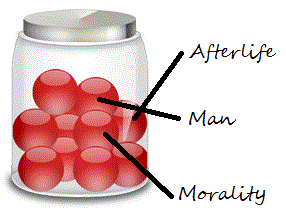
You see, many people believe that their worldview is like a jar full of marbles. In that jar are placed all of their individual beliefs about things, and they can scoop out beliefs that they don't like, examine them in isolation, and toss them out as they get more evidence.
Picture
This compartmentalization is radically unbiblical. God's Word makes it clear that our faith and our beliefs affect each other. Ultimately, those beliefs affect our actions as well. It is so sad when a Christian, unaware of what he is doing, swallows the secular idea of compartmentalization. It is this dogma that allows people to live hypocritically in opposition to their stated beliefs. Their views may contradict in so many areas, yet because they think in the "marbles in a jar" type fashion, they are content with this being the case. We must recognize that a "marbles in a jar" worldview construction is false and not the reality of things.

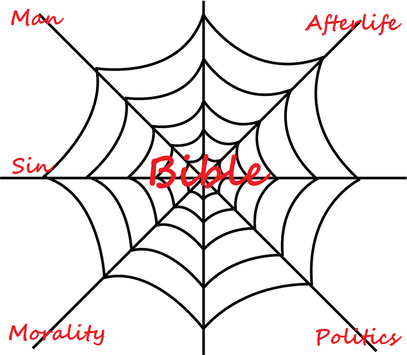
Instead of marbles in a jar, a worldview is truly a network of beliefs. It is much more helpful to think of a worldview as a spiderweb. At the center we have the ultimate authority of the particular worldview in question, and we have each of the beliefs branching off as natural consequences of the worldview's ultimate authority:
Picture
The great goal of this philosophy is really to make sure that all of the beliefs that we hold are consistent with the ultimate presupposition that we adopt. Note that this ultimate presupposition affects every area of your life. Whether the matter be a simple one of thought, an ethical matter, or an important doctrine that colors how you view everything in the world.

Again, it is quite unfortunate that many Christians hold to many beliefs that are not consistent with their ultimate authority or presupposition. Non-Christians do this constantly because they are created in God's image with a conscience and yet adopt an ultimate authority that is not His word. As such, they often support things that are proper and godly, yet those very things are not consistent with or even diametrically opposed to their stated ultimate authority. As we will discuss in apologetics posts in the future, one of our great goals is to show them their inconsistencies and push them to carry out the logical conclusions of their ultimate authority to the very end.

However, this should not be the case among Christians. Properly developed, ALL beliefs of every Christian should either be explicitly taught in the Bible (their ultimate authority) or derived from it of necessary consequence. Additionally I will add that in theory, Christians should never have disagreements. If all Christians were to think consistently and derive their beliefs on ALL subjects from their ultimate authority, then we would all agree. In practice, we would actually have some minor disagreements about the matters that are of "necessary consequence," but those disagreements would be FAR out on the edges of the web. In actual reality, we see Christians fundamentally differing on a WIDE variety of important issues. It is my assertion that these disagreements result from a failure to think in a proper fashion, ultimately compartmentalizing thoughts and developing differing perspectives on subjects that are actually antithetical from the stated ultimate authority. Bahnsen continues:
You must defend the Christian faith as a package deal. Every particular human experience, thought, or sensation must be seen and understood within the context of a broader system of interpretation of those things. Each part of a worldview must relate to every other part.3
While Bahnsen is focused upon the apologetic implications of this concept, I want to bring you to something more fundamental. Christianity is not simply adding another marble marked "Jesus" to your worldview jar. Christianity is a radical supplanting of your entire frame of thinking, replacing your ultimate authority and reexamining each of your individual beliefs to make sure that they are derived from that authority. If they are not, they must be rejected.

"So therefore, any one of you who does not renounce all that he has cannot be my disciple." Lk 14:33

-tanner

1 Gary DeMar, ed., Pushing the Antithesis: The Apologetic Methodology of Greg L. Bahnsen (Powder Springs, GA: American Vision, 2007), 42.

2 Ibid, 43.
3 Ibid, 43.

0 Comments
<<Previous
Forward>>

    Archives

    September 2014
    August 2014

    Categories

    All
    Christian Living
    Church History
    Devotional Thoughts
    Evangelism And Apologetics
    Politics
    Recommended Resource
    Theology

    RSS Feed